Why Your Toronto Home’s Water Pressure is Important
What Is Water Pressure and Why Does It Matter in Toronto?
Water pressure is the force that pushes water through your home’s pipes and out of every faucet, showerhead, and appliance. It is measured in pounds per square inch (PSI) and directly affects how well your plumbing system functions on a daily basis.
For Toronto homeowners, water pressure deserves special attention. The city’s municipal supply delivers water at pressures that often exceed what residential plumbing is designed to handle. Aging infrastructure in neighbourhoods like The Annex, Cabbagetown, and East York can create unpredictable pressure fluctuations. Homes at higher elevations, such as those in the Bridle Path or parts of North York, may experience naturally lower pressure because the water must travel uphill from treatment facilities.
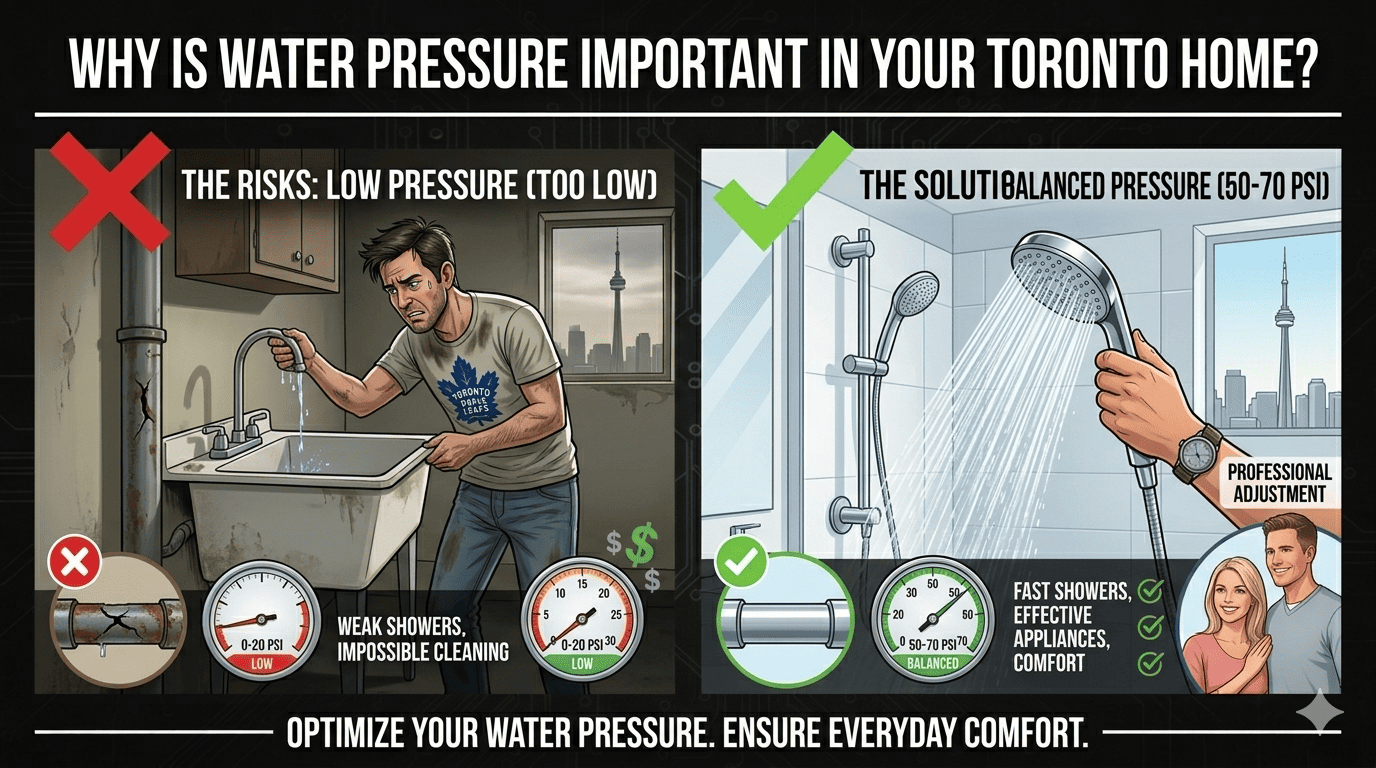
Key Insight: The ideal water pressure range for a Toronto home is 40–60 PSI. Anything below 30 PSI feels noticeably weak, while readings above 80 PSI can actively damage your plumbing.
What Is the Ideal Water Pressure for a House in Toronto?
The recommended water pressure for residential properties in Toronto falls between 40 and 60 PSI, with 50 PSI considered the optimal target for most homes. This range balances strong, satisfying flow from fixtures with safe operating conditions for pipes and appliances.
PSI Range |
Classification |
Impact on Your Home |
| Below 30 PSI | Too Low | Weak flow, slow-filling appliances, poor shower performance |
| 30–39 PSI | Low | Usable but noticeably reduced output, especially on upper floors |
| 40–60 PSI | Ideal | Strong, consistent flow with safe operating conditions for all plumbing |
| 61–80 PSI | High | Functional but increases stress on joints, valves, and connectors |
| Above 80 PSI | Dangerous | Risk of burst pipes, leaking fixtures, and appliance failure |
Toronto’s municipal water supply can deliver pressures ranging from 50 to over 100 PSI depending on your neighbourhood, elevation, and proximity to pumping stations. This is why a properly functioning pressure regulator is essential for every Toronto home.
How Do You Check Water Pressure in a Toronto Home?
Testing your home’s water pressure is a straightforward process that any homeowner can do in under five minutes with an inexpensive gauge from a local hardware store.
Step-by-Step Method
- Purchase a water pressure gauge with a hose-thread fitting from any Toronto hardware store. They typically cost between $10 and $20.
- Turn off all water-using fixtures and appliances in your home, including dishwashers, washing machines, and any running taps.
- Attach the gauge to an outdoor hose bib or a laundry room faucet. An outdoor spigot closest to your water meter provides the most accurate reading.
- Open the valve fully and read the PSI on the gauge dial.
- Test at different times of day. Pressure often drops during peak morning and evening hours when neighbourhood demand is highest.
Key Insight: If your gauge reads below 40 PSI or above 80 PSI, your home needs professional attention. Readings that fluctuate wildly throughout the day may indicate a failing pressure regulator or a problem with the municipal supply line.
What Causes Low Water Pressure in Toronto Homes?
Low water pressure is one of the most common plumbing complaints among Toronto homeowners. Several factors, both within and outside your property, can contribute to the problem.
Municipal and Infrastructure Causes
- Aging city water mains, particularly in older Toronto neighbourhoods built before the 1970s, can develop internal corrosion and mineral buildup that restricts flow.
- Seasonal demand spikes during summer months when outdoor watering peaks can temporarily reduce pressure across entire blocks.
- Planned or emergency City of Toronto water main repairs may reduce pressure for hours or days at a time.
- Homes located at higher elevations relative to the nearest pumping station naturally receive lower pressure due to gravity.
Internal Household Causes
- Corroded galvanized steel pipes, common in Toronto homes built before the 1960s, gradually narrow from mineral buildup on interior walls.
- A malfunctioning or improperly set pressure reducing valve (PRV) can throttle incoming pressure too aggressively.
- Partially closed main shutoff valves, sometimes accidentally bumped during basement renovations, restrict flow to the entire house.
- Clogged aerators and showerheads filled with sediment or calcium deposits, which are common with Toronto’s moderately hard water.
- Running multiple water-using fixtures simultaneously in homes with undersized supply lines.
What Causes High Water Pressure in Toronto Homes?
While less immediately noticeable than low pressure, excessively high water pressure is actually more dangerous because it silently damages your plumbing system over time.
- A failed pressure reducing valve (PRV) that no longer regulates incoming municipal pressure, allowing full city pressure into your home.
- Thermal expansion in your water heater can cause temporary pressure spikes if no expansion tank is installed.
- Proximity to a municipal pumping station or being located at a lower elevation in the city’s water distribution network.
- Seasonal changes in municipal supply pressure, particularly during low-demand periods in winter when overall neighbourhood usage drops.
Key Insight: High water pressure above 80 PSI can reduce the lifespan of your water heater, dishwasher, and washing machine by up to 30–50 percent. It is a leading cause of pinhole leaks in copper pipes, which are widespread in Toronto’s housing stock.
What Are the Signs of Water Pressure Problems?
Recognizing the symptoms early can prevent expensive repairs. Here is how to identify pressure issues in your Toronto home before they escalate.
Signs of Low Pressure
- Showers feel weak or take a long time to rinse soap and shampoo.
- The washing machine or dishwasher takes significantly longer to complete a cycle than it used to.
- Toilets are slow to refill after flushing.
- Water barely trickles from upper-floor taps when a ground-floor fixture is in use.
Signs of High Pressure
- Loud banging noises in the pipes, known as water hammer, when fixtures are shut off.
- Faucets and toilets frequently drip or leak despite having newer internal components.
- The washing machine hose bulges or the dishwasher supply line shows signs of stress.
- Your water heater’s temperature and pressure relief valve discharges water periodically.
- Unusually high water bills without a corresponding change in your usage habits.
How Does Water Pressure Affect Your Plumbing and Appliances?
Water pressure has a direct relationship with the health and longevity of every component in your home’s plumbing system. Understanding this relationship helps Toronto homeowners make informed maintenance decisions.
Impact on Pipes
Consistently high pressure stresses pipe joints, soldered connections, and fittings throughout your home. In Toronto, where many homes have copper or older galvanized steel piping, this stress accelerates wear. Pinhole leaks in copper pipes are a particularly common consequence, often appearing first in basement runs and behind walls where they can cause significant hidden water damage.
Impact on Appliances
Dishwashers, washing machines, ice makers, and water heaters all have internal valves, seals, and hoses rated for specific pressure ranges. When pressure consistently exceeds 80 PSI, these components degrade faster, leading to premature failure and costly replacements. Water heaters are especially vulnerable because high incoming pressure combined with thermal expansion creates extreme internal stress.
Impact on Fixtures
Faucet cartridges, toilet fill valves, and showerhead diverters wear out much faster under high pressure. Many Toronto homeowners find themselves repeatedly replacing the same faucet components without realizing that excessive water pressure is the root cause.
Key Insight: A single burst pipe from high water pressure can cause $5,000 to $50,000 or more in water damage to a Toronto home. A pressure reducing valve that costs a few hundred dollars to install or replace can prevent this entirely.
What Is a Pressure Reducing Valve and Does Your Toronto Home Need One?
A pressure reducing valve (PRV) is a bell-shaped device installed on your main water supply line, typically near where the line enters your home. Its function is to reduce the incoming municipal water pressure to a safe level for residential plumbing, usually between 40 and 60 PSI.
Most Toronto homes connected to the city’s municipal water supply have a PRV, or should have one. The city’s distribution system can deliver water at 80 PSI or higher in many areas, which exceeds safe residential operating levels.
When Should You Replace Your PRV?
- The valve is more than 10–12 years old, which is the typical service life for most residential PRVs.
- You notice a sudden and sustained increase in water pressure throughout the house.
- Pressure fluctuates significantly throughout the day without a clear explanation.
- You hear a humming or vibrating noise near the main supply line.
- Your water pressure gauge shows readings above 80 PSI at the incoming supply.
How Can Toronto Homeowners Fix Low Water Pressure?
The correct solution depends entirely on the underlying cause. Here are the most effective approaches ranked from simplest to most involved.
Quick DIY Fixes
- Clean or replace clogged faucet aerators and showerheads. Soak them in white vinegar overnight to dissolve mineral deposits.
- Check that the main shutoff valve near your water meter is fully open. Even a quarter-turn restriction can noticeably reduce pressure.
- Inspect the pressure reducing valve setting. Some PRVs have an adjustment screw that allows you to increase the output pressure within safe limits.
Professional Solutions
If DIY fixes do not resolve the problem, a licensed plumber can diagnose and address deeper issues. Common professional solutions include replacing a failed or degraded PRV, installing a booster pump for homes with consistently low municipal supply, re-piping sections of corroded galvanized steel with modern copper or PEX tubing, and flushing the main water supply line to clear sediment buildup.
How Can Toronto Homeowners Protect Against High Water Pressure?
Protecting your home from high pressure damage requires a few targeted measures.
First, install or replace your pressure reducing valve. This is the single most effective defence against high pressure. A licensed plumber can install a new PRV for most Toronto homes in under two hours. Second, add a thermal expansion tank to your water heater system. This absorbs pressure spikes caused by heating water in a closed plumbing system. Third, test your pressure every six months using a gauge. Catching a failing PRV early prevents the cascade of damage that high pressure causes throughout your system.
Key Insight: The Ontario Building Code requires that residential water pressure not exceed 80 PSI. If your home’s pressure consistently exceeds this limit, it is both a safety risk and a code compliance issue
Does Water Pressure Affect Your Water Bill?
Yes. Higher water pressure means more water flows through your fixtures per minute, even when you are using them normally. A home running at 100 PSI uses approximately 30–40 percent more water than the same home at 50 PSI with identical usage habits. Over the course of a year, this translates to hundreds of extra dollars on Toronto’s water and wastewater charges.
Conversely, low pressure can indirectly increase costs by forcing appliances like dishwashers and washing machines to run longer cycles to fill properly, using more electricity in the process.
Key Insight: Maintaining optimal water pressure between 40 and 60 PSI is one of the simplest ways to reduce both your water bill and your energy costs without changing your daily habits.
How Often Should Toronto Homeowners Test Water Pressure?
At a minimum, homeowners should test water pressure twice per year, ideally in spring and fall. Spring testing catches any changes caused by winter freeze-thaw cycles that may have shifted underground pipes or affected your PRV. Fall testing ensures your system is stable before the cold months when a burst pipe would cause maximum damage.
You should also test immediately after any noticeable change in water behaviour, such as sudden drops in flow, new banging sounds in the pipes, or unexplained increases in your water bill. Any home renovation that involves the plumbing system should include a pressure test before and after the work is completed.
When Should You Call a Licensed Plumber for Water Pressure Issues?
While minor issues like clogged aerators are simple DIY tasks, several situations require professional expertise.
Call a licensed plumber when your pressure reading is above 80 PSI or below 30 PSI, when you suspect your pressure reducing valve has failed, when multiple fixtures throughout the house show pressure symptoms simultaneously, when you hear persistent water hammer or pipe vibration, when you have an older Toronto home with galvanized steel pipes and declining pressure, or when you notice unexplained water damage that may indicate a pressure-related leak behind walls or under floors.
A licensed Toronto plumber will perform a comprehensive diagnostic that includes measuring static and dynamic pressure at multiple points, inspecting the condition of the PRV, assessing the pipe material and diameter throughout the home, and checking for hidden leaks using specialized detection equipment.
Toronto Water Pressure Summary
Question |
Answer |
| What is the ideal water pressure for a Toronto home? | 40–60 PSI, with 50 PSI as the recommended target. |
| When is water pressure dangerously high? | Above 80 PSI. Risk of burst pipes and appliance damage. |
| How do you test water pressure at home? | Attach a pressure gauge ($10–$20) to a hose bib with all fixtures off. |
| What does a pressure reducing valve do? | Reduces incoming municipal pressure to a safe residential level. |
| How often should you test water pressure? | Twice per year (spring and fall) and after any noticeable change. |
| Does high pressure increase water bills? | Yes. Homes at 100 PSI use roughly 30–40% more water than homes at 50 PSI. |
| When should you call a plumber? | Pressure above 80 PSI, below 30 PSI, or when the PRV appears to have failed. |
Plumbing Problem? Call Us Today
Plumbing Problem? Call Us Today