

Hidden Risks of DIY Drain Snakes
What Exactly Is a DIY Drain Snake?
A drain snake – also called a hand auger or plumbing snake – is a flexible metal cable coiled inside a drum, designed to be manually fed into a drain to break apart or retrieve blockages. Consumer-grade models are sold at hardware stores for $25–$80 and are marketed as simple, safe, and effective for household clogs.
They come in two common types: a hand-crank manual snake for sinks and tubs, and a motorized drum auger for deeper lines. Neither version includes the diagnostic capability to identify what is causing the blockage before the cable makes contact with it.
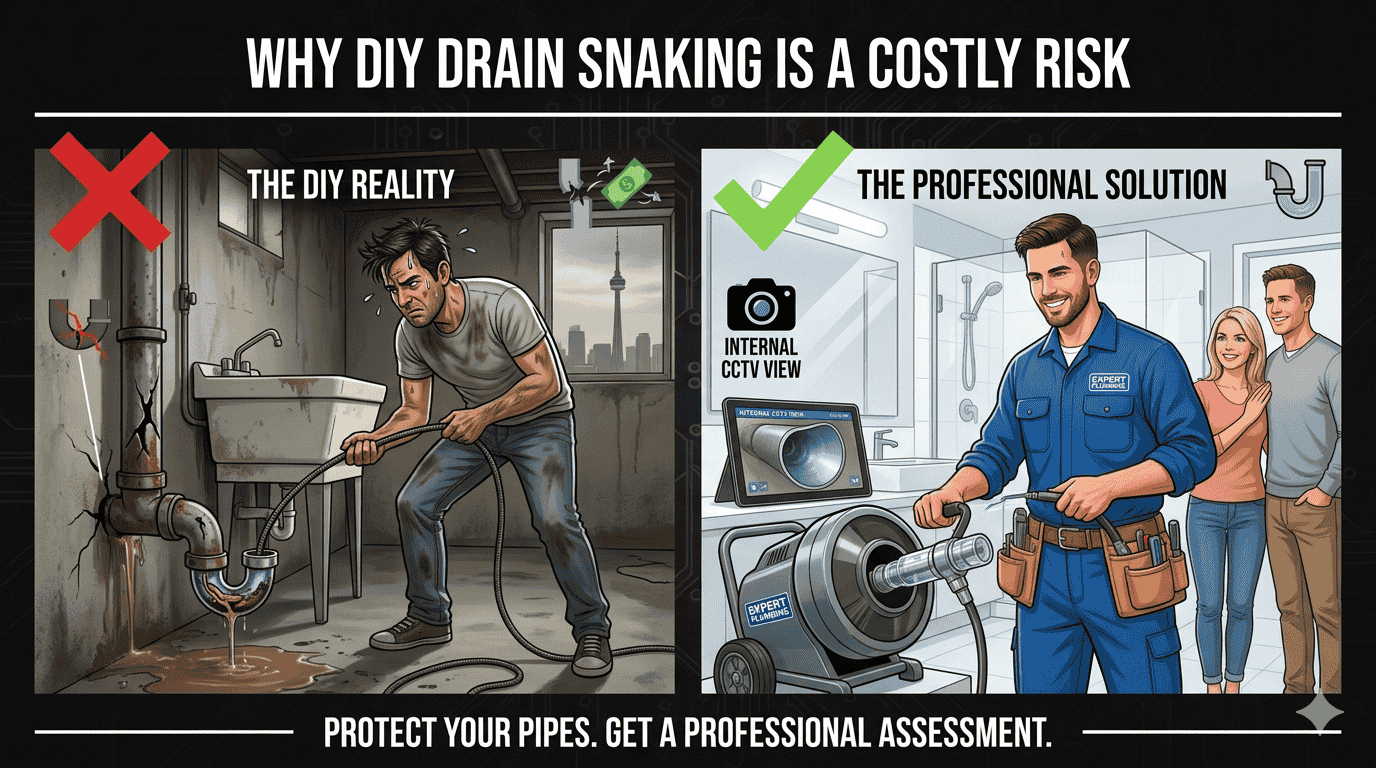
Key Insight A drain snake is a blunt instrument used without visibility. It contacts whatever is in the pipe – clog, pipe joint, corroded section, or tree root – with equal force and no feedback to the user.
Can a Drain Snake Damage Your Pipes?
Yes – and it is one of the most underreported DIY plumbing injuries homeowners cause to their own homes. The metal cable of a consumer snake is rigid and unguided once inside the pipe. When it meets resistance – a bend, a joint, a partial clog – it exerts lateral force against pipe walls rather than passing cleanly through.
Which pipe types are most at risk?
- PVC pipes: The cable tip can gouge the interior surface, creating rough edges that accelerate future buildup.
- Older cast iron pipes: Already prone to internal corrosion, they can crack or flake under snake contact.
- Clay sewer pipes: Common in homes built before 1980, extremely brittle and vulnerable to perforation.
- Corrugated flexible lines: Found under sinks and in some basement installations – cable tips can puncture the ribbing.
Warning Hairline cracks caused by snaking may not leak immediately. They often show up weeks or months later – after water pressure has widened them – making it difficult to trace the cause back to the DIY attempt.
Can DIY Snaking Make a Clog Worse?
Yes – in three specific and common scenarios. Without camera inspection, the user has no way to know the nature, location, or composition of the blockage before the snake reaches it.
Scenario 1: The snake bypasses the clog
The cable finds a gap around a soft blockage (grease, hair, soap) and passes through without engaging it. The homeowner feels resistance release and assumes success. The clog remains, now pushed slightly further along.
Scenario 2: The snake compacts a soft clog
Organic material – congealed grease, accumulated hair, food matter – can be packed tighter by a rotating cable rather than broken apart. What was a partial blockage becomes a dense, harder-to-clear plug.
Scenario 3: The snake cannot address the real cause
Tree root intrusion, collapsed pipe sections, and mineral scale deposits cannot be cleared with a manual snake under any circumstances. Forcing the cable into these conditions risks breaking the snake, locking it inside the pipe, or fragmenting a pipe wall.
Key Insight Plumbers estimate that roughly 30–40% of repeat drain service calls involve a DIY snaking attempt that failed to resolve – or actively worsened – the original blockage.
What Are the Personal Safety Risks of Using a Drain Snake?
Consumer drain snakes are not passive tools. The spinning cable carries stored rotational energy and behaves unpredictably when it meets resistance inside a pipe. Several categories of physical injury are documented in plumbing trade literature and emergency room reports.
Cable whip and laceration
When a spinning cable kinks or snaps back from a blockage, it can whip out of the drain opening at speed. The metal tip and cable body can cause deep cuts to hands, wrists, and forearms. This is the most common snake-related injury in DIY plumbing.
Chemical exposure
Many homeowners apply chemical drain cleaners before reaching for the snake. Sodium hydroxide (lye), sulfuric acid, and bleach-based products linger in standing water and on pipe surfaces. Snake rotation splashes this contaminated water. Contact with eyes causes chemical burns; inhalation of fumes in an enclosed bathroom causes respiratory irritation.
Warning Never use a drain snake immediately after pouring a chemical drain cleaner. Residual chemicals in the water will be aerosolized by the rotating cable. Always flush the drain with water and allow 30+ minutes before using any mechanical tool.
Sewage exposure
Drain snakes retrieve and disturb sewage-laden material. Bacteria including E. coli, Salmonella, and hepatitis A virus have been identified in household drain waste. Without nitrile gloves, eye protection, and a full change of clothing, the risk of contamination transfer to skin and surrounding surfaces is significant.
Shoulder and wrist strain
Motorized drum snakes generate considerable torque. Inexperienced users who grip the cable rather than the drum handle absorb that torque through the wrist and shoulder, causing sprains and in some cases fractures of the wrist when the cable locks.
Why Is Combining Drain Cleaners and Snaking So Dangerous?
Chemical drain cleaners are designed to dissolve organic matter through heat-generating chemical reactions. When a drain snake is used in a pipe that still contains these chemicals, several problems converge simultaneously.
- Heat reaction: Sodium hydroxide and sulfuric acid products react with water to produce significant heat – enough to soften and warp PVC pipe from the inside.
- Corrosion acceleration: The chemicals continue dissolving material after the clog – including pipe joints, rubber gaskets, and metal fittings in older systems.
- Aerosolization: Snake rotation creates a spinning vortex that lofts chemical droplets out of the drain opening at face level.
- Neutralization failure: If two different drain cleaner products are present (acid-based and bleach-based), the snake agitates them into direct contact, potentially producing chlorine gas in a confined space.
Critical Risk Mixing an acid-based drain cleaner with a bleach-based product – even residual amounts – and then agitating with a snake can produce chlorine gas. In an enclosed bathroom, this reaches harmful concentration levels within minutes.
What Problems Does DIY Snaking Fail to Detect?
A drain snake treats symptoms, not causes. A homeowner who successfully clears a blockage with a snake has no way to know whether the drain ran slowly due to a simple clog or an underlying structural problem that will recur – and worsen – without proper attention.
Conditions a snake cannot diagnose or treat:
- Tree root intrusion: Roots infiltrate pipe joints and grow inward. A snake cuts through small roots temporarily but cannot seal the entry point. Roots regrow within weeks.
- Pipe bellying: A section of pipe that has settled and sagged collects waste at the low point. Snaking clears the immediate blockage but the belly remains and refills.
- Partial pipe collapse: Older clay or concrete sewer pipes can partially collapse. A snake can push debris through or lock against the collapsed section.
- Hardened mineral scale: Calcium and magnesium deposits build up on pipe interiors over years, progressively narrowing the diameter. A snake passes through but does nothing to the scale.
- Offset joints: Ground movement can shift pipe sections out of alignment. Snaking across an offset joint risks scoring the pipe edge or lodging the cable.
Key Fact A recurring drain problem – one that responds to snaking but returns within days or weeks – is almost always a sign of a structural issue rather than a simple clog. Each snake attempt delays accurate diagnosis.
DIY Drain Snake Risk Summary
Risk Category |
What Goes Wrong |
Potential Cost |
| Pipe Damage | Scratches, cracks, or perforations from metal cable | $500–$4,000+ in pipe repair |
| Worsened Clog | Blockage compacted deeper into the line | $200–$800 for hydro-jetting |
| Chemical Burns | Contact with drain cleaner residue on skin or eyes | Medical treatment required |
| Sewage Contamination | Bacteria and pathogens spread to surfaces | Professional biohazard cleanup |
| Cable Kink / Locking | Snake binds inside pipe, requires extraction | $150–$500 for retrieval |
| Missed Root Cause | Underlying issue (roots, collapse) left untreated | $1,000–$10,000+ long-term |
DIY Drain Snake vs. Professional Drain Clearing – What’s the Difference?
Factor |
DIY Drain Snake |
Professional Plumber |
| Diagnosis | None – working blind | Camera inspection confirms issue |
| Clog removal | Partial – may push clog deeper | Complete – clears or extracts root cause |
| Pipe safety | Risk of scratching or cracking | Correct tools matched to pipe material |
| Chemical exposure | High if drain cleaners were used | Plumber aware of and manages hazards |
| Sewage handling | No protective protocol | PPE, containment, and sanitation standard |
| Post-job verification | Unknown – assumed fixed | Flow test confirms full clearance |
| Upfront cost | ~$30–$80 (snake rental) | $150–$400 (full service) |
| Risk of repeat call | High – root cause often missed | Low – issue properly resolved |
When Should You Stop DIYing and Call a Plumber?
Most minor, one-time blockages in a single fixture (a bathroom sink, a shower) can reasonably be attempted with a hand snake or plunger – once. If any of the following conditions apply, stop and call a licensed plumber before using a snake.
Stop and call a professional if:
- Multiple drains are slow or backing up simultaneously – this indicates a main line issue, not a fixture-level clog.
- The drain has been slow for more than two weeks – accumulation suggests structural narrowing, not a recent clog.
- You have already tried snaking once and the problem returned – recurrence confirms an underlying issue.
- The home is more than 40 years old with original plumbing – fragile pipe materials require camera inspection before any tool is inserted.
- You smell sewage gas from the drain – a venting or trap problem that a snake will not fix and may make worse.
- Chemical cleaners have already been applied – the risk of chemical exposure during snaking is not worth the attempt.
What Are the Safer Alternatives to DIY Drain Snaking?
For minor, surface-level clogs:
- Cup plunger: Effective for toilet and sink blockages within 12–18 inches of the drain opening. No pipe contact, no risk.
- Drain hair catcher removal: Many shower slowdowns are caused by hair accumulation at the drain screen – removable by hand with gloves.
- Boiling water flush: Effective for grease buildups in kitchen drains with metal pipes only. Do not use on PVC.
- Baking soda and white vinegar: Creates a mild fizzing reaction that can loosen early organic buildup. Safe, non-corrosive, no pipe contact.
For recurring or unclear blockages:
- Enzyme-based drain treatments: Biological enzymes digest organic material over 24–72 hours without pipe contact or chemical risk. Best used monthly as prevention.
- Professional camera inspection: A licensed plumber inserts a waterproof camera to identify the exact nature and location of the problem before any tool touches the pipe.
- Hydro-jetting: High-pressure water clears blockages, scale, and roots completely. Performed by professionals with equipment calibrated to pipe diameter and material.
Bottom Line If a plunger and drain screen cleaning do not resolve the issue within one attempt, the risk profile of DIY snaking – pipe damage, chemical exposure, sewage contamination, missed diagnosis – outweighs the potential savings of a professional service call.
Things to Remember
A drain snake is not a diagnostic tool – it is a physical intervention applied without visibility into what it is contacting. For a one-time, minor, single-fixture clog in a modern home, the risk is manageable. For anything more complex – recurring clogs, multiple slow drains, older pipes, chemical pre-treatment, or unknown blockage type – the hidden risks of DIY drain snaking consistently outweigh the cost of a professional service call.
The true cost of DIY snaking is not the $40 rental fee. It is the potential for a $500 pipe repair, a $1,500 sewer scope and extraction, or a $10,000 main line replacement that a proper diagnosis would have caught and managed at the source.
This guide is intended for informational purposes. For any drain issue beyond a single minor clog,
consult a licensed plumber before using any mechanical drain tool.
Plumbing Problem? Call Us Today
Plumbing Problem? Call Us Today