

Advantages of Having a Battery-Operated Backup Sump Pump
What Is a Battery-Operated Backup Sump Pump?
A battery-operated backup sump pump is a secondary pump installed alongside your primary sump pump. It runs on a rechargeable battery and activates automatically when the primary pump cannot function – whether due to a power outage, mechanical failure, or overwhelming water volume. Unlike water-powered backup systems, battery backups work independently of your home’s water pressure or electrical supply.
Quick Answer
A battery backup sump pump protects your basement from flooding when your main pump stops working – especially during the storms and power outages when you need protection most.
Core Advantages of a Battery-Operated Backup Sump Pump
1. Does It Work When the Power Goes Out?
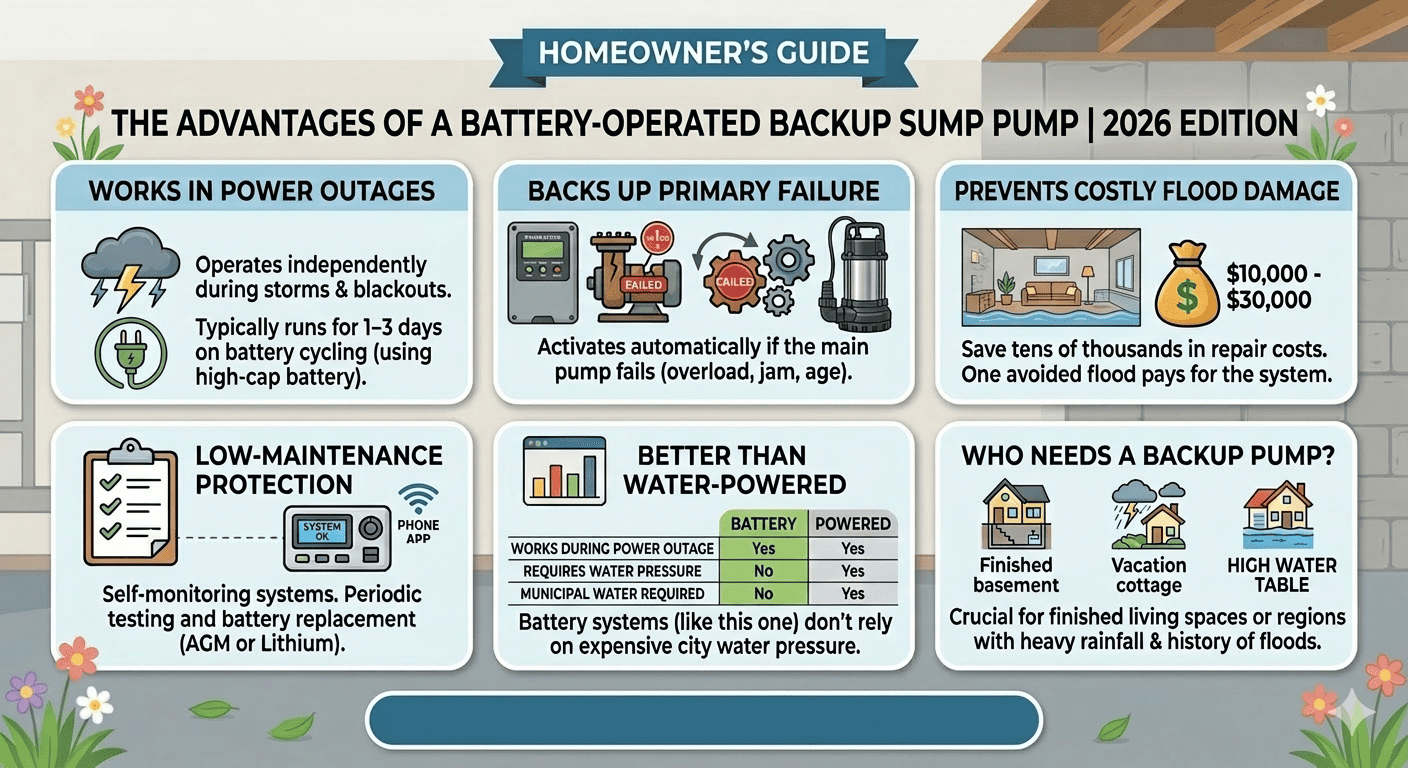
Yes – and this is its most critical advantage. Severe storms that cause basement flooding are the same events most likely to knock out your power. A battery-operated backup sump pump stores power in advance and operates completely independently of the electrical grid.
During a typical power outage, a fully charged backup battery can run the pump continuously for 5 to 7 hours, or cycle on and off for 1 to 3 days depending on water inflow.
Key Fact
Power outages and heavy rainfall frequently coincide. A battery backup is specifically designed for exactly this scenario – protecting you when standard systems fail most.
2. What Happens If the Primary Sump Pump Fails?
The backup pump activates automatically. Most battery backup systems monitor water levels with a float switch set slightly higher than the primary pump’s trigger point. If the primary pump is overloaded, broken, or jammed, the backup engages without any manual intervention.
Primary pump failure causes include:
- Burned-out motor from continuous cycling
- Switch failure from debris or corrosion
- Overwhelm during extremely heavy rainfall
- Age-related mechanical breakdown
3. How Much Flood Damage Can a Backup Sump Pump Prevent?
A single basement flood event costs homeowners an average of $10,000 to $30,000 in repairs, depending on the extent of water damage, structural impact, and whether finished living space is affected. Mold remediation alone can add $3,000 to $10,000 to that total.
A battery backup sump pump – which typically costs $200 to $500 installed – can prevent all of that with a single activation.
Cost Perspective
The battery backup pays for itself the first time it prevents a flood. One avoided basement flood saves 20x–60x the cost of the system.
4. Is a Battery Backup Sump Pump Difficult to Maintain?
No. Battery backup sump pumps are among the lowest-maintenance home protection systems available. Here is what routine maintenance looks like:
- Test the system every 3–4 months by unplugging the primary pump
- Inspect battery terminals for corrosion twice per year
- Check the water level in the sump pit periodically
- Replace the battery every 3 to 5 years
Most modern systems include a monitoring alert that notifies you when the battery charge is low or when the backup has been triggered – removing the need for constant manual checks.
5. Does It Work Better Than a Water-Powered Backup Pump?
For most homes, yes. Here is a direct comparison:
|
Feature |
Battery Backup |
Water-Powered Backup |
|
Works during power outage |
Yes |
Yes |
|
Requires water pressure |
No |
Yes |
|
Pumping speed |
High (up to 2,000 GPH) |
Moderate (varies) |
|
Municipal water required |
No |
Yes |
|
Ongoing water costs |
None |
Yes (uses water to pump water) |
|
Works in rural areas |
Yes |
Not always |
6. Who Needs a Battery-Operated Backup Sump Pump?
A battery backup sump pump is strongly recommended for any homeowner who:
- Lives in a region with frequent storms or heavy rainfall
- Has a finished basement used as living space
- Has experienced basement flooding in the past
- Lives in an area with a high water table
- Owns a vacation or secondary property that may be unoccupied during storms
- Has had a primary sump pump failure before
Even homes that have never flooded benefit – because the primary pump itself can fail for reasons unrelated to weather.
7. How Long Does the Battery Last During an Outage?
Battery runtime depends on how frequently the pump cycles and how much water is entering the sump pit. General estimates:
- Continuous pumping: 5–7 hours on a fully charged battery
- Intermittent cycling (typical storm conditions): 1–3 days
- Standby charge without activation: battery holds charge for several months
Higher-capacity battery systems (such as AGM or lithium batteries) provide longer run times than standard lead-acid batteries.
Battery Types
AGM (Absorbed Glass Mat) batteries are the most common choice – they are maintenance-free, spill-proof, and hold charge well. Lithium batteries offer longer life but at a higher upfront cost.
8. Can a Battery Backup Handle the Same Volume as a Primary Pump?
Most battery backup sump pumps are rated between 1,000 and 2,000 gallons per hour (GPH) at 0 feet of lift. This is slightly lower than high-capacity primary pumps (which can reach 3,000–4,000 GPH), but sufficient to manage water during most basement flooding scenarios.
For homes with extremely high water inflow, a combination of a high-capacity primary pump and a battery backup with a large-capacity battery is the optimal setup.
Summary: Battery Backup Sump Pump Advantages at a Glance
Advantage |
Key Benefit |
Who Needs It Most |
|
Power Outage Protection |
Operates on battery during blackouts |
Homes in storm-prone regions |
|
Flood Prevention |
Activates when primary pump fails |
Basements with finished living space |
|
Primary Pump Backup |
Handles overflow during heavy rain |
Properties with high water tables |
|
Low Maintenance |
Battery lasts 3–5 years |
Busy homeowners |
|
Cost Savings |
Avoids $10,000–$30,000 flood damage |
Homeowners without flood insurance |
|
24/7 Monitoring |
Alerts when battery is low |
Vacation or second homes |
A battery-operated backup sump pump is one of the highest-value home protection investments available to basement homeowners. It costs a few hundred dollars, requires minimal maintenance, lasts 3–5 years per battery cycle, and can prevent tens of thousands of dollars in water damage. It works specifically when you need it most – during storms that cut power and overwhelm primary systems.
This guide is intended for homeowners researching sump pump protection options. For installation and sizing advice specific to your home, consult a licensed plumber.
Plumbing Problem? Call Us Today
Plumbing Problem? Call Us Today